
// Sector /terrain · guide
The lunar surface: sweep lanes, not fields
Cleaning feedback is visible and progress is tracked, which is exactly what makes lane discipline possible — and why wandering is so expensive.
The surface is a state machine you can see
Moon Sweepers gives you unusually direct feedback for a cleaning game: dusted terrain turns clean behind the brush, and the surface keeps a record of how much you have covered. There is no ambiguity about whether your last pass worked.
That feedback is what makes planning possible. If you can see the boundary between cleaned and uncleaned terrain, you can sweep in lanes and know when a lane is done, instead of rubbing a patch and hoping.
Lanes, not fields
The single most effective habit in the game is finishing one lane before starting another. It sounds trivial and it changes the arithmetic of a session completely.
A completed lane is progress you never have to revisit. A wide area swept patchily is a region you will re-cross repeatedly, and every re-cross is scrubbing time spent on ground that was already clean in places. The recording behind this manual shows exactly that pattern: the player is most productive when they pick a strip, run it edge to edge, and turn around, and least productive when they wander.
Sweep in lanes. A lane is a unit of work you can finish. A field is a unit of work you can only survey.
Edges are where the brush misbehaves
In the recorded session, the most consistent irritation is the brush riding up on raised edges and panel boundaries, making the head skip or lurch. That is a terrain feature, not a bug to work around: the surface has structure, and the brush interacts with it.
The practical response is to run narrow strips along a boundary before trying to sweep across it, and to accept that some terrain types need the percussion hammer rather than the brush. If a pass produces no visible cleaning, changing tools is cheaper than scrubbing harder.
Open world, low gravity, real traversal cost
The store listing tags the game open world, and the surface is large enough that distance matters. Movement is low-gravity, which means a jump commits you to a long, slow descent — observed repeatedly as a source of friction in the recorded run.
That makes traversal a resource. Time spent crossing the surface is time not cleaning, which is why depot placement and strip planning matter more here than the raw size of the map suggests.
What progress means, and what it does not
The store copy states that progress is tracked across the lunar surface, and that terrain visibly turns clean. It does not publish a completion target, a percentage threshold for unlocks, or any reward schedule tied to total area cleaned. Those specifics are unannounced.
What the design implies is that the surface is deliberately larger than any one session. A recorded five-hour run cleans a section and is nowhere near finished. Treat the map as a workspace you return to rather than a level you complete.
Surface routine
- Pick a lane edge that runs toward your depot, so the walk home is on ground you already finished.
- Run it end to end before turning.
- Break for a depot trip at the end of the lane, not mid-lane.
- Switch to the hammer the moment a patch stops responding to the brush.
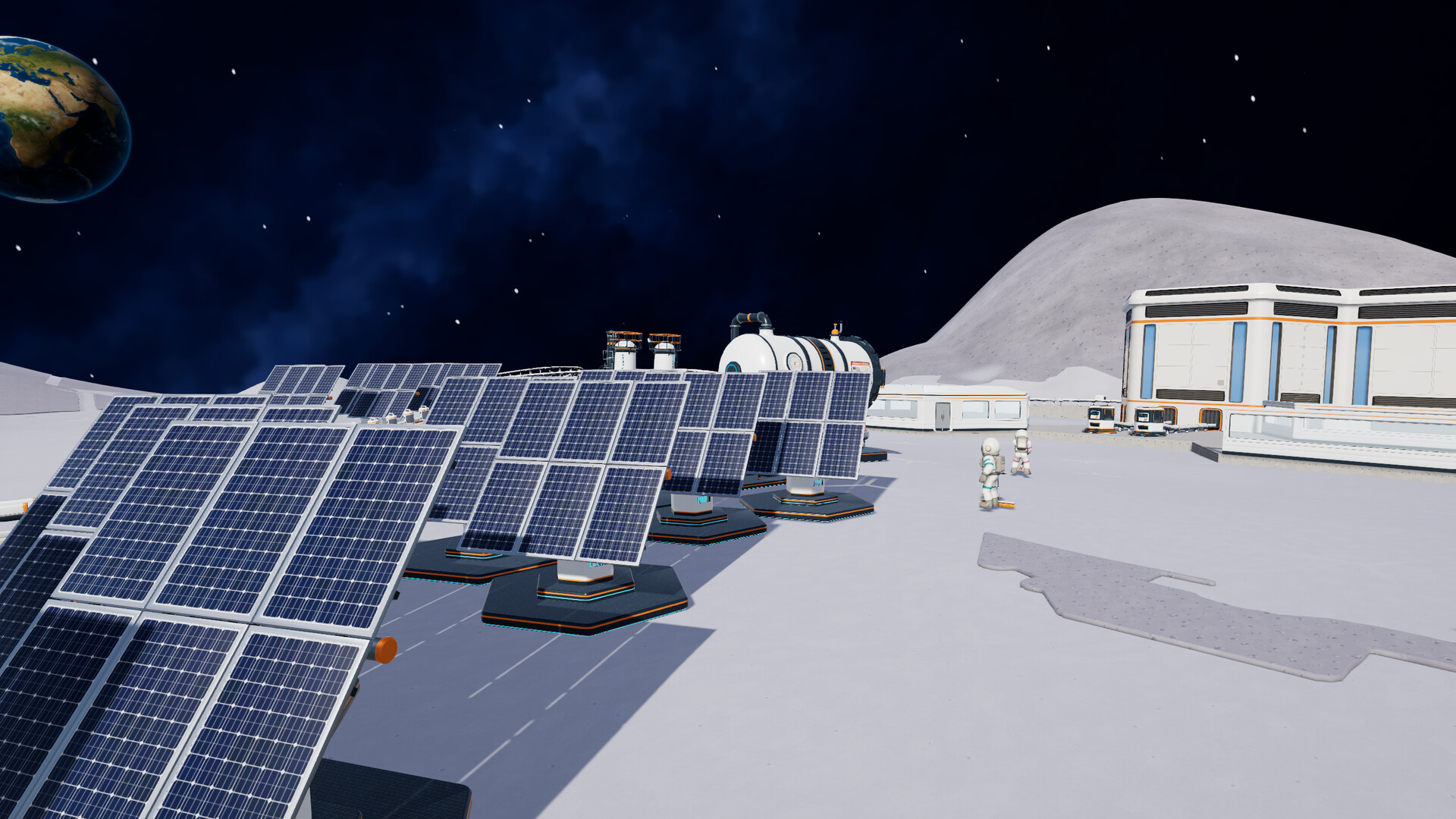
Reading the dust itself
The surface tells you two things at once: whether a patch is clean, and roughly how dense the dust was. Dense patches take more passes and fill the canister faster; thin patches sweep clean in one movement and return almost nothing.
That makes route planning a density problem rather than a distance problem. The shortest lane is not the best lane if it runs through thin dust; a slightly longer lane through a dense field returns more per minute of scrubbing.
Because the change is visible, this is learnable without a map overlay. Sweep a short test pass in a few directions, see which one darkens the terrain fastest, then commit a full lane to that heading.
What the progress tracking is for
The store copy states that progress across the surface is tracked. Whatever form that takes in the interface, its practical function is to answer one question: is this lane finished, or does it look finished from here?
Lanes are easier to finish than areas precisely because they have an end. An area's boundary is invisible while you are inside it, so a player sweeping an area stops when they feel done, which is usually before the area is actually clean. A lane stops when you reach the end of it.
This is the whole argument for lane discipline, and it is a UX argument as much as an efficiency one. The game gives you a shape you can complete; take it.
Traversal costs that are easy to miss
Low gravity means every jump is a commitment. The ascent is quick and the descent is not, so a player who jumps habitually spends a surprising fraction of a session airborne and unable to clean.
Movement speed upgrades exist in the tool tree for exactly this reason: they do not raise your cleaning rate, they reduce the dead time between cleaning. Whether they are worth buying depends on how much of your session is spent walking, which is another way of saying it depends on depot placement.
On a well-planned operation with a nearby depot, traversal is a minor cost and speed upgrades are optional. On a badly planned one, they are a patch over a problem that costs nothing to fix properly.
Working a large surface without a map screen
- Anchor to the depot. Start every session by facing away from it and working outward, so the return trip is always downhill in effort terms.
- Sweep in a grid, not a spiral. Parallel lanes are easy to resume; a spiral has no obvious resumption point if you stop mid-way.
- Leave a visible marker. A strip of uncleaned ground between two finished lanes is the cheapest boundary marker available.
- End sessions at a lane boundary, never in the middle of one. The next session then starts with a clear task.
Next: cleaning vehicles, or splitting the surface across a crew.